After Stage 1
One week after enrolling on the course
Each Stage is released to you weekly.
It takes at least a week for the changes you will be making to take place - from the practical exercises beginning at Stage 1, and then from Stage 3 onwards, also the concepts and different way of thinking involved.
The process in the CBT for Tinnitus E-Programme has evolved through what now amounts to some 30 years in clinical practice, and over those years with some TEN THOUSAND patients:
NHS Tinnitus Clinics for the first 17 of those years, and then
Since 2010, with patients all over the world using Zoom video platform - the same one I will be using with you during your Tinnitus E-Programme course
Use the process as I have set it out in this course and it will work for you too.
You don't need to be burdened by pages and pages of reading materials. In fact, where tinnitus distress is significant, most people couldn't cope with that anyway. It will soon become clear to you why as you progress through the course.
Stage 2 is therefore still straightforward, and is there to help understanding about how making changes is a process, and cannot be rushed. Physiological changes need to take place (throughout your Autonomic Nervous System) and I want to be sure that you feel comfortable about expectations you have for yourself.
Before we bring about a change, we need to pass through a "transition" stage - where we are moving from to where we are going! From how we feel now to how we want to feel. Stage 2 begins to prepare you to move through that transition phase.
As well as the relatively short reading pieces in each of the Stages, I use diagrams for clarification in most of the materials. We all learn differently, some of us can learn from reading text alone, whereas others benefit from seeing drawings and representations in diagram form, as well as video.
Whenever I find additional materials that aid your learning, this course is updated with those materials.
Two weeks after enrolling
After 2 weeks, the vast majority of people begin to notice changes in how they feel physiologically.
Blood flow is improving throughout the body - including most significantly blood flow to the neocortex (specifically the PFC - pre-frontal cortex).
Stage 3 focuses on the significance we attach to sounds. For example, most human beings feel calm when they hear nature sounds like sea waves.
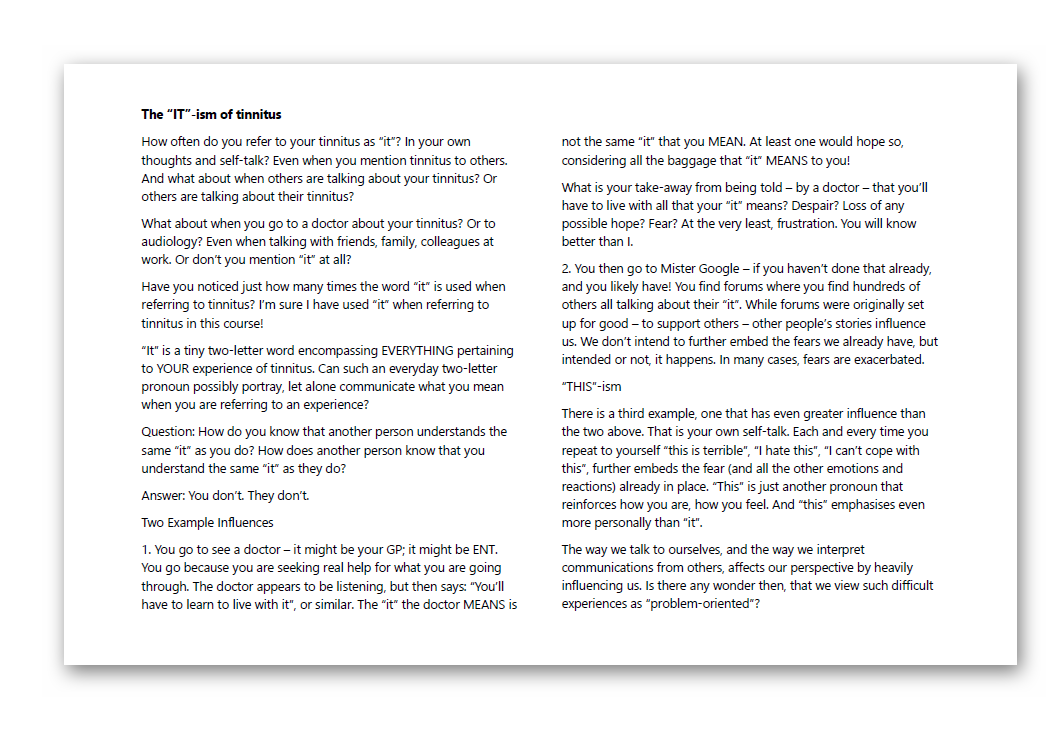
It is also in Stage 3 where I start to introduce the cognitive element of the process. Cognitive means 'thinking', 'understanding'. It's about the "meaning" behind our thoughts and beliefs. There are a couple of exercises to try out to test the "meaning" behind what your thoughts and beliefs are about your tinnitus, for example. Examples are there to help you with this. Stage 3 takes "meaning" further, in to self-talk and everyday language we use, and then introduces Part 1 (of two parts - the second is in Stage 4) of taking in to account a 'Costs & Benefits Transaction', introducing PERSPECTIVE: a problem-oriented perspective vs a recovery-oriented perspective.
Here is an out-take from the section, used as an example to link MEANING to the Costs & Benefits Transaction:
Weekly SITREP
It is very important that you use the process in this programme AT YOUR OWN PACE. Any process must fit the individual. Processes fail when there is an expectation for individuals to fit a process. Were you to be attending appointments at a clinic, you would go through the process at a pace that suits your needs. The weekly SITREP is an email that you send in each and every week. Details about the SITREP, when and how to use it are on the CBT for Tinnitus E-Programme website. Click the button for details:
Your 1-1 using Zoom
1-1 appointments are carried out using Zoom.
The optimum time for your first 1-1 with me is 4-6 weeks after starting using the course. You can use the Booking Form for your preferred day and time of day
I have worked remotely since 2012, so even if meeting up on a screen is new to you, it isn't to me.
You do need a good internet connection, which most of us have nowadays, and you can use a computer with camera, microphone and audio, a tablet or a smart phone.
Most one-to-ones are around 60-90 minutes (average 1 hour 20 minutes). We will have been in touch by email and via your logs and Progress Checks so I'll have a good idea about your needs by then, plus you will have completed a Mini-history.
Additional 1-1 appointments
97% of users don't need additional 1-1 time. However, if there is a need for additional 1-1 time to those you are entitled to as a user of the Tinnitus E-Programme, additional appointments cost £120.00 for one or £340 for three appointments.
Additional 1-1 appointments have been requested by people when there are issues IN ADDITION to tinnitus distress, for example, an unresolved sleep problem (most commonly already resolved after the initial few weeks of the course), a vestibular balance problem (help is available for vestibular rehab), or unresolved pre or co-existing anxiety (including GAD, OCD) and/or depression.